- Payment Options
- Terms Conditions
- Malibu 453 blv
- info@charity.com

Notice: Test mode is enabled. While in test mode no live donations are processed.

The struggle for Sikh self-determination and the demand for an independent Khalistan have been central to the Sikh political discourse for decades. The Sovereign Sikhs advocate for Khalistan as a necessary step toward justice, dignity, and self-rule for Sikhs. This article examines global perspectives on self-determination, the systematic oppression of Sikhs by the Indian state, how Australia’s shared values align with Sikh aspirations, and the mutual benefits for Australia and Khalistan post-independence.
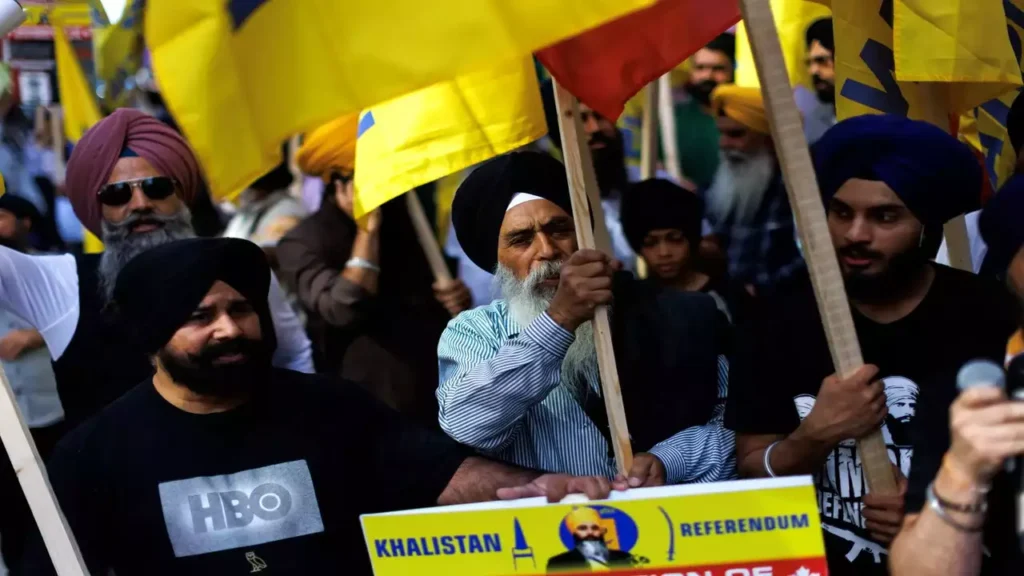
Self-determination is a fundamental principle of international law, enshrined in the United Nations Charter (Article 1.2) and the International Covenant on Civil and Political Rights (ICCPR, Article 1).
Globally, several nations have exercised self-determination, including:
The Sikh struggle for Khalistan follows similar patterns, rooted in historical sovereignty, political oppression, and the denial of basic rights.
The Sikhs have faced systemic oppression under Indian rule, particularly post-1947. Despite being at the forefront of India’s freedom struggle, Sikhs have been sidelined, discriminated against, and subjected to state-sponsored violence.
o Sikhs were assured autonomy before India’s independence, which was later denied.
o The Punjab Reorganization Act (1966) further divided Punjab, weakening Sikh political power.
o The Indian government launched Operation Bluestar in June 1984, attacking Sri Harmandir Sahib (Golden Temple), killing thousands of innocent Sikhs.
o Following Prime Minister Indira Gandhi’s assassination, mobs, led by Indian National Congress leaders, massacred over 30,000 Sikhs in Delhi and across India.
o Despite decades of activism, justice remains elusive as perpetrators walk free.
o Punjab police, under KPS Gill’s leadership, executed thousands of Sikh youth in fake encounters.
o Human Rights Watch and Amnesty International documented mass graves and illegal cremations in Punjab.
o Sikhs advocating for Khalistan are labeled “terrorists” under India’s draconian UAPA law.
o Farmers protesting anti-Sikh farm laws faced brutal crackdowns in 2020-2021.
o Sikh political prisoners, including Jagtar Singh Johal, remain imprisoned under fabricated charges.
Australia stands as a beacon of democracy, human rights, and multiculturalism—values that align with the Sikh struggle for self-determination. The Sikh diaspora in Australia is growing, actively participating in politics, business, and community development.
Why Australia Should Support Khalistan:
o Australia has historically supported self-determination movements (e.g., East Timor). Recognizing Sikh sovereignty aligns with its global stance on freedom and justice.
o Like Australia, Khalistan would be based on democracy, religious freedom, and secular governance—a contrast to India’s growing Hindu majoritarianism.
o Australian Sikhs have significantly contributed to agriculture, infrastructure, and law enforcement, fostering strong community ties.
The Sovereign Sikhs firmly believe that Khalistan is not just a dream but a necessity for Sikh survival and progress.
Core Reasons for Supporting Khalistan:
o Sikhs ruled the Punjab region under Maharaja Ranjit Singh (1799-1849) before British colonization.
o The forced merger of Punjab into India in 1947 ignored Sikh aspirations.
o Sikhs face increasing marginalization under India’s Hindutva-driven policies.
o A sovereign Khalistan would preserve Sikh religious, linguistic, and cultural heritage.
o Khalistan would provide a safe haven for Sikhs, free from state-sponsored persecution.
o Punjab’s economy is crippled due to anti-Sikh policies, farmer suicides, and drug epidemics.
o Khalistan would enable sustainable agriculture and industrial growth, benefiting global trade partners.
An independent Khalistan would create new geopolitical, economic, and cultural opportunities for Australia.
Strategic & Economic Benefits for Australia:
o Punjab is India’s agricultural backbone. An independent Khalistan could emerge as a global agri-export powerhouse, providing Australia with new trade routes.
o Given India’s growing alignment with authoritarian regimes, Khalistan could offer Australia an alternative defense & intelligence ally in South Asia.
o Australian firms could invest in Punjab’s infrastructure, technology, and renewable energy sectors, benefiting both nations.
o With a free Khalistan, the Sikh diaspora in Australia would play a crucial role in economic and diplomatic relations, fostering bilateral ties.
The demand for Khalistan is rooted in history, justice, and the undeniable right of self-determination. The Indian state’s oppression of Sikhs has only strengthened the global Sikh movement for sovereignty. Australia, as a democratic nation, must recognize the legitimacy of this cause, much like it did for East Timor.
The Sovereign Sikhs remain committed to peaceful advocacy, political engagement, and global alliances to ensure that the Sikh nation finally attains its rightful place on the world map.
• Educate: Share this article within your community.
• Advocate: Engage with Australian lawmakers to recognize the Sikh struggle.
• Unite: Join Sovereign Sikh initiatives to amplify the movement.
Khalistan Zindabad! ✊🏽
Lorem ipsum dolor sit amet, consectetuer adipiscing elit aenean comm odo ligula eget dolor massa Lorem ipsum dolor sit amet, consectetur adipiscing elit. Aenean egestas magna at porttitor vehicula nullam.